She Arrived Without a Word of English — and Dressed Manhattan Anyway
The garment district in midtown Manhattan is not a gentle place. It never has been. It's a world of fast talk and faster deals, of showroom politics and sample deadlines, of buyers who've heard every pitch and sellers who've learned to read a room in seconds. The entire industry runs on language — on schmoozing, negotiating, charming, and closing. It is, in almost every sense, a verbal sport.
So what happens when someone who can't speak the language walks in anyway?
For Luba Volk, a Ukrainian immigrant who arrived in New York City in the early 1990s with three hundred dollars, a suitcase of fabric samples, and essentially zero English, the answer was: she listened harder than anyone else in the room.
The Suitcase That Started Everything
Volk had been a textile worker in Kyiv, trained in the Soviet system's rigorous approach to craft — precise, disciplined, allergic to waste. When the USSR collapsed, the industry she'd worked in evaporated almost overnight. She was in her early thirties, skilled, ambitious, and suddenly without a path forward in the country she'd always called home.
A cousin in Brooklyn offered a couch and a vague promise of opportunity. Volk took it.
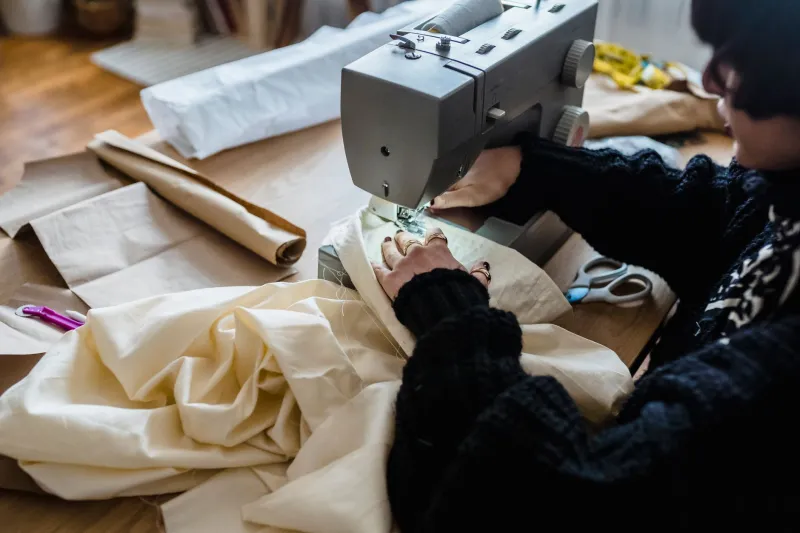
Her first years in New York were the kind of grinding, unglamorous experience that immigration stories tend to gloss over in the retelling. She worked in alterations shops in Queens, taking in hems and replacing zippers for wages that barely covered her share of a shared apartment. Her English consisted of numbers, fabric terms, and apologies. She communicated almost entirely through her hands — through the quality of a seam, the precision of a cut, the way she could look at a garment and see exactly what it was trying to be.
That, it turned out, was its own kind of fluency.
The Observation Advantage
Because Volk couldn't participate in the constant chatter of the workrooms and showrooms she moved through, she watched. Obsessively. She noticed which samples the buyers touched twice. She tracked which colors drew people in and which ones stopped them cold. She saw the gap between what the salespeople claimed customers wanted and what those customers actually reached for when left alone with a rack.
In a business where everyone was talking, she was the only one really looking.
By the mid-1990s, she had saved enough to rent a small production space in the Garment District and begin making her own pieces — structured knit separates that borrowed from her Eastern European training but interpreted them for the American body and the American closet. The silhouettes were clean, functional, and quietly luxurious in a way that didn't announce itself.
She sold her first pieces out of a rolling rack at a weekend market in Chelsea. She had no pitch. She had no story, at least not one she could tell in English. What she had was the product, and she let buyers handle it without interruption — which, in a market full of aggressive sellers, was almost radical.
People bought. They came back. They brought friends.
Building Without the Benefit of the Room
The language barrier that should have stopped Volk at every turn kept creating unexpected advantages. When she eventually got a small showroom and began meeting with retail buyers, she couldn't fill the silence the way other vendors could. She couldn't paper over a weak product with a confident narrative. The clothes had to do the talking.
So she made sure they could.
She also found that her inability to fully follow rapid-fire negotiations made her a more careful reader of body language. She watched hands, posture, the direction of a buyer's gaze. She became extraordinarily good at sensing when a deal was real and when it was just politeness — a skill that veteran salespeople spent careers trying to develop and that Volk had sharpened simply by having no other option.
Her interpreter during those early showroom years, a fellow Ukrainian émigré named Darya, later recalled that Volk frequently stopped negotiations to ask her to wait — not because she hadn't understood the words, but because she'd noticed something in the buyer's expression that the words hadn't captured. "She'd say, 'Ask them what's really wrong,'" Darya remembered. "And there was always something. She always saw it."
The Brand That Silence Built
By the early 2000s, Volk's label — eventually named simply VOLK, at the suggestion of an American business partner who convinced her that the single word carried exactly the right weight — was carried in independent boutiques across the Northeast. Her pieces were the kind that stylists discovered and quietly kept to themselves, the kind that fashion editors wore off-duty and never quite credited publicly.
The brand never had a massive marketing budget. It didn't need one. Its reputation moved through the industry the way things moved before social media existed — through touch, through whisper, through the particular loyalty of a customer who'd found something that fit her life rather than just her body.
Volk eventually hired staff, found vendors, and built the operational infrastructure of a real company. Her English improved, though she remained characteristically quiet in meetings — a habit so ingrained by then that it had become part of her brand identity. She was the designer who listened. In a room full of people talking about what women wanted, she was the one who'd spent twenty years finding out.
What the Silence Taught Her
Volk's story is, at its core, a story about constraint as catalyst. The language barrier that should have made the garment district impossible to crack instead forced her to develop a set of observational and empathetic skills that most of her competitors never bothered to build because they didn't have to.
She couldn't rely on charm. She couldn't rely on narrative. She couldn't talk her way into a room or out of a bad deal. She had only what she could make and what she could see — and she made both of those things extraordinary.
Manhattan didn't exactly welcome her. But it couldn't ignore her either.
Sometimes the people who can't speak the language are the ones who finally hear what's being said.