While the City Slept, They Were Building: The Night Workers Who Quietly Changed American Business
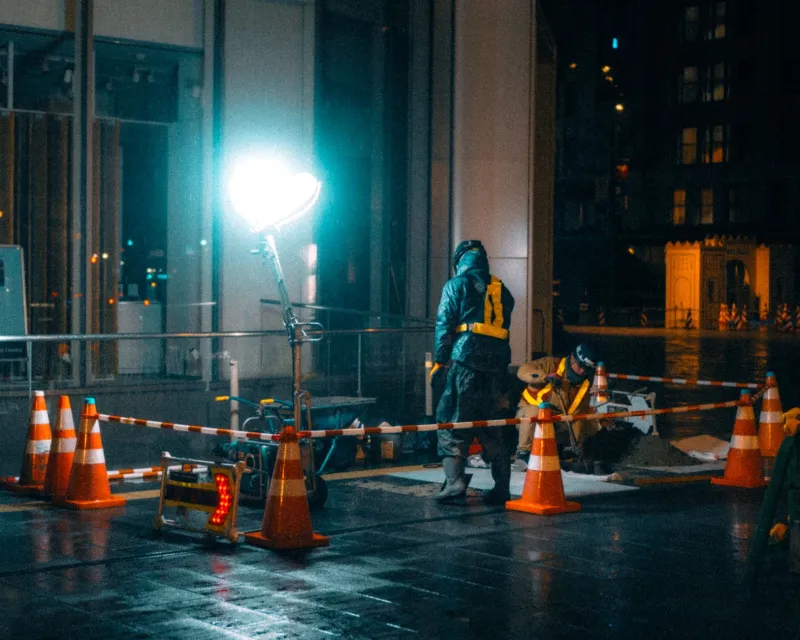
At three in the morning, most of America is asleep. The office towers are dark. The lobbies are quiet. The only people moving through them are the ones nobody really sees — the janitor running a buffer across the marble floor, the security guard doing rounds on the fourteenth floor, the overnight cleaner who knows every corner of a building that hundreds of daytime employees use but none of them could describe.
These are the invisible jobs. The ones that don't show up on highlight reels or TED stages. The ones that exist specifically so that the daytime world doesn't have to think about what it takes to keep things running.
And for a remarkable number of people who would go on to reshape American business, culture, and science, these were the jobs that made everything else possible.
The Gift Nobody Advertised
There's something the overnight shift offers that most people never think about: time.
Not free time, exactly. But uninterrupted time. The kind that's nearly impossible to find during daylight hours when phones ring, managers circulate, and the social demands of being present consume every available minute.
The overnight janitor works alone. The security guard sits with his thoughts for stretches that daytime employees would find unbearable. The cleaner moves through empty space with a mind that's technically on the job but largely unencumbered by the noise that fills waking life for everyone else.
For immigrants and first-generation Americans in particular — people who arrived without credentials, connections, or capital — these hours were often the only ones available for the kind of deep thinking, planning, and building that eventually produced something remarkable.
The Man Who Cleaned Offices and Built a Software Company
In the late 1980s, a young man named Jan Koum arrived in Mountain View, California from a small village in Ukraine. He was sixteen. His family was on food stamps. His mother cleaned houses to keep them afloat.
Koum got himself a job as a janitor at a grocery store, taught himself computer networking from manuals he bought secondhand, and eventually landed an entry-level position at Yahoo. The habits formed in those early years — intense focus, radical frugality, a deep discomfort with anything that felt like excess — never left him.
In 2009, he co-founded WhatsApp with Brian Acton. The app was built with a philosophy almost aggressively opposed to the advertising-driven model that dominated Silicon Valley: no ads, no games, no gimmicks. Just clean, functional messaging.
Facebook acquired WhatsApp in 2014 for $19 billion.
Koum showed up to sign the paperwork at the Mountain View social services office where his family had once collected food stamps. He wanted to remember.
The Security Guard Who Watched and Listened
The security job has a particular quality that distinguishes it from other overnight work: it requires alertness without action. You're watching for something that, on most nights, never comes. Which means your mind, if you're the right kind of person, goes to work on other things.
Multiple founders and innovators have described overnight security work as a kind of unexpected incubator. The solitude is enforced. The distractions are minimal. And if you bring a notebook — or, in later decades, a laptop — you have something rare in a busy life: uninterrupted hours to think through a problem from beginning to end.
One of the more striking examples is Ursula Burns, who grew up in a housing project on Manhattan's Lower East Side, where her mother ran a childcare operation out of their apartment to make ends meet. Burns worked whatever jobs she could find while pursuing her engineering degree, eventually landing at Xerox as an intern. The discipline she'd developed working around a demanding home environment and marginal resources translated directly into the focused, unglamorous persistence that drove her rise to become Xerox's CEO in 2009 — the first Black woman to lead a Fortune 500 company.
The overnight ethic — do the invisible work, do it well, keep going — ran through her story from the housing project to the boardroom.
The Cleaner Who Saw What the Executives Missed
There's an argument to be made that the people who clean office buildings understand those businesses better than most of the people who work in them.
They see which departments work late and which ones clear out by five. They see the whiteboards that never get erased, the desks that are always buried, the conference rooms that are always booked. They move through the physical reality of an organization in a way that executives, insulated in their corner offices, rarely do.
For the entrepreneurially minded, that perspective is data.
Solomon Trujillo, who grew up in Cheyenne, Wyoming in a Mexican-American family with limited resources, worked a series of unglamorous jobs before building a career that eventually took him to the CEO position at Telstra, one of Australia's largest telecommunications companies, and US West. He has spoken about how early experiences working in environments where he was overlooked gave him an unusual ability to see operational realities that people higher up the chain consistently missed.
The view from the bottom of an organization, it turns out, is often the clearest one.
What the Night Teaches That the Day Can't
There's a resilience that develops in people who maintain two lives simultaneously — the one that pays the rent at midnight and the one they're building toward when nobody's watching.
The overnight worker who's also an entrepreneur doesn't have the luxury of a bad day. They can't take a mental health afternoon or coast through a slow week. Every hour is accounted for. Every hour costs something. That constraint, brutal as it is, produces a particular kind of discipline that's almost impossible to develop in more comfortable circumstances.
It also produces humility. The founder who once mopped floors has a hard time pretending that any kind of work is beneath them. They've already done the invisible labor. They know what it costs and who does it.
The Hours Nobody Counted
The stories in this piece share a common architecture: someone arrives with very little, takes whatever work is available, and uses the margins of that work — the quiet hours, the uninterrupted stretches, the solitude — to build something that the comfortable world wasn't building.
America has always told a story about hard work and opportunity. What it tells less often is the version where the hard work happens in the dark, in an empty office building, in a uniform nobody notices, while the people who will eventually write the success story are sound asleep.
The night shift didn't hold these people back. In most cases, it was the only school they could afford — and it turned out to teach the things that mattered most.
The floors got mopped. The buildings got watched. And somewhere in the quiet between rounds, an idea got written down that the morning would eventually have to reckon with.