She Wasn't Supposed to Teach Math — Then She Changed How America Learns It
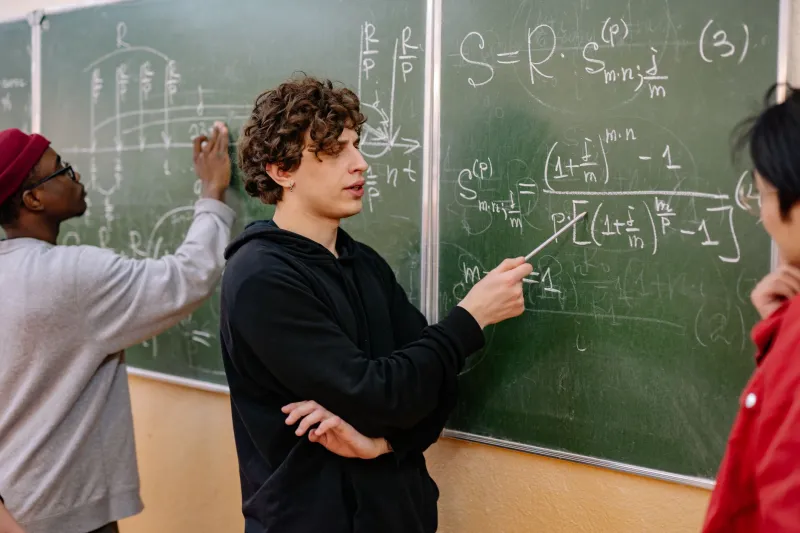
The morning Donna Ferris walked into Room 14 at Jefferson Middle School in Dayton, Ohio, she was carrying a substitute teacher's badge, a cup of gas station coffee, and approximately zero confidence in what she was about to do.
The assignment: cover an eighth-grade pre-algebra class for a teacher out on medical leave. Expected duration: a few days, maybe a week. Actual duration: six months. And by the time the original teacher returned, something had shifted in that classroom that nobody — least of all Donna — had planned for.
The Accidental Assignment
Donna Ferris had spent most of her working life in jobs that required her to figure things out on the fly. She'd managed a diner for eight years, done bookkeeping for a small construction company, and raised three kids largely on her own after her husband left. She had a community college associate's degree in business administration and a reputation among people who knew her for being able to explain complicated things in plain English.
She'd started substitute teaching in her mid-forties as a way to fill gaps between bookkeeping contracts. She was good at it — not because she had formal training in education, but because she was patient, direct, and genuinely unbothered by the social dynamics that make many adults uncomfortable around teenagers.
When the school called about the math assignment, she almost said no. She'd covered English, history, even a memorable week of home economics. Math felt different. More technical. More likely to expose her.
She said yes anyway, because the rent was due.
The Moment She Realized the Book Was the Problem
For the first few days, Donna did what substitutes do: she followed the lesson plan left by the absent teacher, pointed at the textbook, and tried to keep order. The kids were disengaged in the particular way that students become disengaged when they've already decided something is impossible — slumped shoulders, eyes on the clock, the specific silence of people who have stopped trying.
The topic was solving for variables in two-step equations. The textbook approached it the way most math textbooks approach abstract concepts: with formal notation, rules presented as rules, and example problems that bore no relationship to anything a 13-year-old had ever actually encountered.
On the third day, Donna put the book down.
"Okay," she said. "Forget the book for a second. Has anyone here ever split a restaurant bill?"
A few heads came up.
She described a scenario: five people at a diner, one shared appetizer, and a total bill of $73. How much does each person owe for their own meal if the appetizer cost $13? The kids worked it out in their heads, or on their fingers, or by talking it through with the person next to them. Within four minutes, nearly every student in the room had the right answer.
Then she wrote the equation on the board and showed them what they'd just done.
Working-Class Intuition Meets Abstract Mathematics
What Donna had stumbled onto — instinctively, without any theoretical framework — was something researchers in math education had been arguing about for decades: the gap between formal mathematical instruction and the informal numerical reasoning that most people actually use in daily life.
For most students, especially those from working-class backgrounds, math class feels like learning a foreign language with no connection to the language they already speak. The concepts aren't unfamiliar — splitting costs, calculating discounts, figuring out how long a drive will take — but the formal presentation strips away all the context that makes those concepts meaningful.
Donna didn't know any of this. She just knew what had worked when she was teaching herself double-entry bookkeeping from a library book, or when she was explaining to a new diner employee how to calculate a percentage tip without a calculator. You start with something real. You let the abstraction follow.
Over the following weeks, she rebuilt the curriculum — unofficially, without permission — around problems pulled from everyday life. Budgeting a road trip. Calculating how long it takes to save for something on a fixed income. Figuring out whether a bulk deal at Costco is actually cheaper per unit. Algebra showed up in all of it, but it showed up as a tool rather than a subject.
Test scores in her class started moving.
The Teacher Who Came Back to a Different Room
When the original teacher returned after six months, she found a class that was, by most measurable indicators, significantly ahead of where it had been. She also found a set of handwritten lesson plans that Donna had left behind — not because anyone asked for them, but because Donna figured they might be useful.
The teacher read them. Then she passed them to the department head. The department head passed them to the district's curriculum coordinator, a woman named Patricia Yuen who had spent years frustrated by the gap between what math education research recommended and what actually made it into classrooms.
Yuen met with Donna over coffee. Then again. Then several more times.
"She wasn't using any of the vocabulary we use," Yuen later recalled. "But she had figured out, from scratch, exactly what we'd been trying to get teachers to do for fifteen years."
From One Classroom to Curriculum Reform
What followed wasn't a straight line. Donna was not offered a permanent teaching position — she lacked the credentials, and the system had rules. But Yuen found ways to bring her into the process anyway: as a consultant on curriculum redesign, as a trainer for new teachers, eventually as a co-developer of a district-wide initiative to embed real-world context into middle school math instruction.
The program that grew from that work spread beyond Dayton. A writeup in a regional education journal caught the attention of a researcher at Ohio State. A pilot program in three other Ohio districts produced results strong enough to attract federal attention. A version of the approach Donna had invented out of necessity — because she had no other tools and a room full of kids who had stopped trying — eventually influenced math curriculum frameworks in multiple states.
Donna still doesn't have a teaching license. She has something rarer: a track record.
What the Credentialed World Keeps Getting Wrong
There's an uncomfortable truth embedded in Donna Ferris's story, and it's one that the education establishment doesn't always love to hear. Innovation in teaching doesn't require a doctorate in pedagogy. Sometimes it requires someone who remembers what it felt like to not understand something — and had to find their own way through.
The formal education system tends to produce teachers who are fluent in the language of their discipline but sometimes disconnected from the experience of encountering it for the first time. Donna had no fluency in mathematical theory. What she had was a vivid memory of figuring out percentages at a cash register and making payroll with a spreadsheet she'd taught herself to use.
She taught from that place. And the kids, who had spent years being taught from somewhere else entirely, responded.
She still subs occasionally. She shows up with her gas station coffee, and she has never once started a lesson with the textbook.
"The book is for after they get it," she says. "First you have to show them they already do."