The Needle That Reached the Stars: How a Small-Town Seamstress Stitched Her Way Into the Space Age
Photo: National Library NZ on The Commons, No restrictions, via Wikimedia Commons
Ruth Calvert learned to sew at her mother's knee in a two-room house outside Findlay, Ohio, which is not the kind of origin story that typically ends with a woman shaping the pressurized suit technology that would eventually carry American pilots to the edge of the atmosphere. But origin stories are funny things. They rarely announce themselves as what they are.
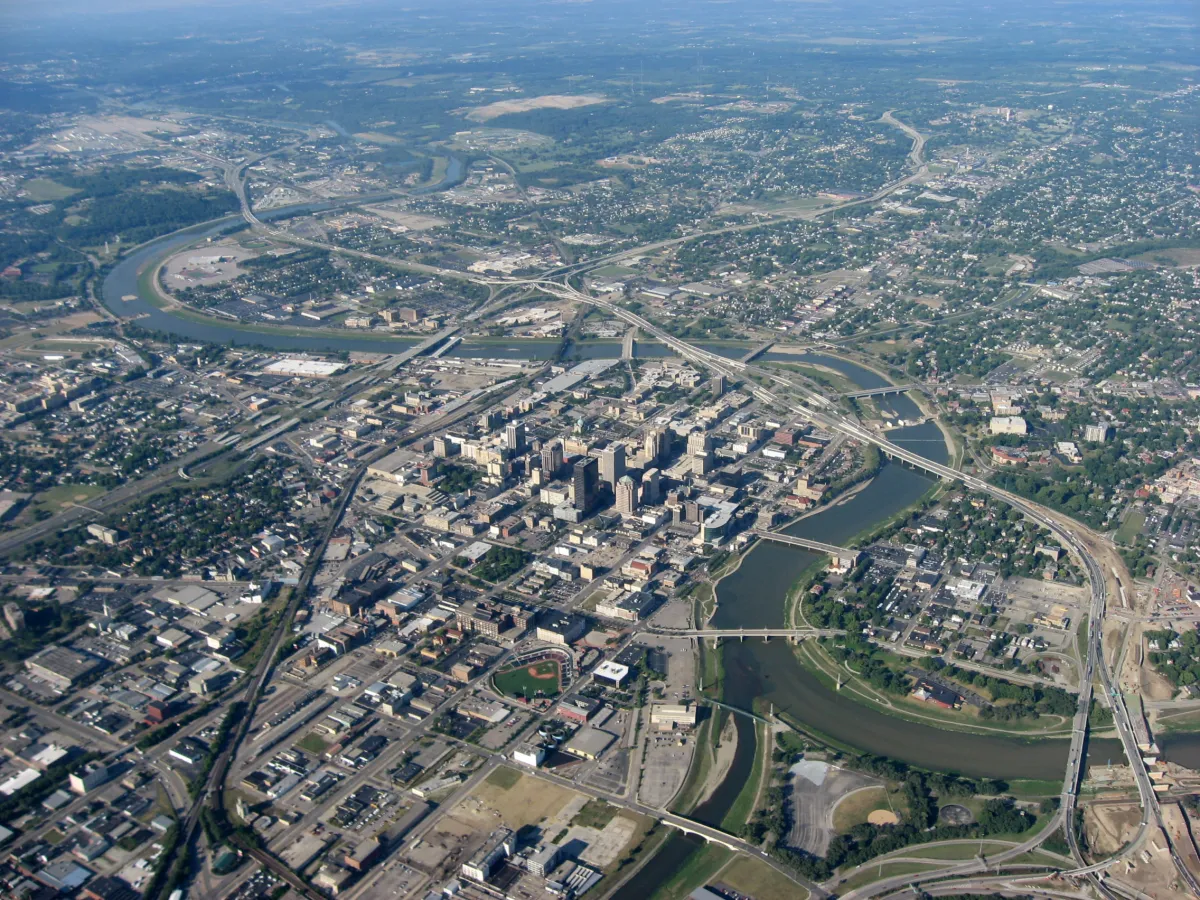 Photo: Dayton, Ohio, via www.goodfreephotos.com
 Photo: Findlay, Ohio, via www.hancockhotel.com
By the time Ruth was twelve, she could hold a seam to tolerances that most adults couldn't match. By sixteen, she was doing alterations for half the women in town and quietly understanding something that no one around her had thought to articulate: that fabric under stress behaves according to rules as precise and unforgiving as anything in an engineering textbook. Pull it wrong and it fails. Reinforce it correctly and it holds against pressures that seem, from the outside, impossible.
She just didn't have the vocabulary to call it engineering. Nobody had given her that word yet.
The Flaw Nobody Wanted to See
In the summer of 1943, Ruth Calvert was twenty-six years old and working on a production line at a textile manufacturing plant in Akron, Ohio, one of dozens of facilities that had pivoted from civilian goods to military contracts after Pearl Harbor. Her job was sewing panels for military parachutes — work that was classified as unskilled labor, paid accordingly, and managed almost entirely by male supervisors who had no background in textile production whatsoever.
 Photo: Akron, Ohio, via c8.alamy.com
Ruth noticed the problem on a Tuesday morning in August. A new batch of nylon panels had come through with a stitching specification that called for a thread tension she recognized immediately as wrong. Not slightly off. Wrong in a way that would cause seam separation under the kind of shock load a parachute experiences at deployment.
She flagged it to her floor supervisor, a man named Gerald Hoskins who had been managing tire production before the war and considered himself, by virtue of his title, an authority on everything that happened in the building. Hoskins looked at the specification sheet, looked at the panels, and told her she was mistaken. The specs had been approved by the contract engineers. The specs were correct.
Ruth went home that night, pulled out her own sewing materials, and ran a series of tests on fabric scraps. She documented her results in a small notebook with the same methodical precision she applied to everything. The seams failed. Every time, at loads well within the operational parameters of a deployed parachute, the seams she'd stitched to the spec sheet's specifications failed.
She went back to Hoskins. He told her to get back to her station.
The Letter That Changed Everything
What Ruth Calvert did next was either brave or reckless, depending on how you look at it. She wrote a letter. Not to Hoskins's supervisor — she'd already learned how that chain of command worked — but directly to the Army Air Forces contracting officer whose name appeared on the facility's production agreement documents, which she had no business reading and read anyway during a lunch break.
The letter was three pages, handwritten, and included her test results, her methodology, and a precise description of the failure point she'd identified in the stitching specification. She mailed it on a Wednesday. By Friday, two men in civilian clothes had arrived at the plant and asked to speak with her.
The specification was quietly revised within a week. Ruth was called into the plant manager's office and informed, with the particular corporate delicacy reserved for situations where management has been embarrassed, that her contract would not be renewed at the end of the current period.
She'd been right. She'd also been fired for being right. This was 1943 in industrial Ohio, and those two facts were not considered contradictory.
The Door That Opened Sideways
What Ruth didn't know, and wouldn't learn until much later, was that one of the two men who had visited the plant had passed her letter on with a note attached. The note said something to the effect that whoever had written the analysis had a working understanding of load-bearing textile structures that exceeded most of the engineers currently working on flexible material contracts.
Six weeks after losing her job in Akron, Ruth received a letter — forwarded twice, once to her parents' address in Findlay — from a manufacturing subcontractor in Dayton working on what the correspondence described only as "flexible pressure membrane components" for aviation applications. They were looking for someone with demonstrated expertise in high-stress textile construction. Would she be interested in discussing a position?
She took the bus to Dayton on a Tuesday and was hired by Friday.
Sewing the Space Age
The work Ruth stepped into in Dayton in late 1943 was part of the early, unglamorous foundation of what would eventually become the American aerospace industry. The "flexible pressure membrane components" turned out to be early prototypes of pressure garments — the precursors to the pressurized flight suits that high-altitude pilots would eventually depend on for survival, and the distant ancestors of the suits that would be worn by the Mercury and Gemini astronauts two decades later.
The engineers she worked alongside were, almost without exception, formally trained men who had come up through mechanical and aeronautical engineering programs. They understood pressure differentials, material stress loads, and the physics of human physiology at altitude. What they often didn't understand was how fabric actually behaved — how a seam could look correct on a specification sheet and fail in practice, how the direction of a stitch relative to a stress vector mattered as much as the thread weight, how the properties of a material changed when it was asked to flex repeatedly under pressure rather than simply hold a static load.
Ruth understood those things instinctively and could now, working alongside people who spoke the language of engineering, begin to translate her knowledge into terms the industry could use.
She wasn't an engineer by credential. She was something that turned out to be rarer: a person who had spent fifteen years developing precision intuition about exactly the problem the industry needed to solve.
What the History Books Missed
Ruth Calvert spent eleven years working in aerospace textile applications before leaving the industry in 1954 to raise a family. Her contributions were never patented in her name — standard practice for contract workers of the era — and her role was not the kind that generated press releases or public recognition. The men who managed the programs she contributed to received the credit, as men in managerial roles reliably did.
What she left behind was embedded in the work itself. Stitching techniques she developed or refined for early pressure garments became standard specifications. Testing methodologies she introduced for seam integrity under cyclic stress load were formalized into protocols that outlasted her involvement by decades.
The knowledge didn't disappear. It just got separated from her name.
The Expertise That Wasn't Supposed to Count
There's a particular kind of dismissal that Ruth Calvert encountered at every stage of her career: the assumption that because her knowledge had been acquired through domestic and industrial sewing rather than formal engineering study, it wasn't really technical knowledge at all. It was craft. It was women's work. It was practical rather than theoretical, and therefore subordinate.
The aerospace industry's early history is full of this dynamic — women whose expertise in textile construction, precision assembly, and quality inspection formed the invisible foundation of programs that celebrated the men who designed them. Ruth's story is one version of a pattern that repeated itself across dozens of facilities and hundreds of careers.
What makes her case worth telling is the specificity of it. She didn't just contribute labor. She identified a structural flaw that trained engineers had missed, documented it with a rigor that impressed people who were paid to be hard to impress, and then spent a decade applying a body of knowledge that her industry needed and had no other way to acquire.
She got there by sewing. By paying attention. By refusing to accept that a specification was correct simply because a man with a title had approved it.
The seams held. That was the whole point.