The Women Who Stitched the Stars and Stripes to the Moon

Photo by Photo by Tanya Barrow on Unsplash on Unsplash
On July 20, 1969, an estimated 600 million people watched Neil Armstrong plant an American flag on the surface of the Moon. It was one of the most photographed moments in human history. The astronauts. The footprints. The flag, stiff and proud against a black sky, looking as though it were caught in a breeze that couldn't possibly exist.
Everybody remembers the astronauts. Almost nobody remembers the women who made the flag possible.
An Assignment Unlike Any Other
In the months before the Apollo 11 mission, NASA's procurement office reached out to Annin & Co., one of America's oldest and most respected flagmakers, headquartered in Roseland, New Jersey, with a manufacturing facility in Verona, Pennsylvania. The agency needed flags. But not just any flags.
These flags had to survive conditions that no flag had ever been asked to endure. The lunar surface swings between roughly 260 degrees Fahrenheit in direct sunlight and negative 280 degrees in shadow — a temperature range that would destroy most conventional materials. There's no atmosphere on the Moon, which means no air pressure, no moisture, and intense ultraviolet radiation that would bleach and degrade standard dyes in short order. And before any of that, the flag had to survive the violence of a rocket launch: the vibration, the g-forces, the heat.
NASA's specifications were extraordinarily detailed. The flag could not be too heavy — every ounce on a lunar mission had a cost measured in fuel and engineering complexity. It couldn't be too large. It had to fold down into a compact package that could be strapped to the side of the lunar module. And it had to look, on camera and in photographs, exactly like the flag Americans knew — crisp, bright, unmistakably itself.
The team at Annin took the assignment seriously. Eleanor Foraker, a veteran seamstress who had spent years working the production floor, was among the workers tasked with making it happen.
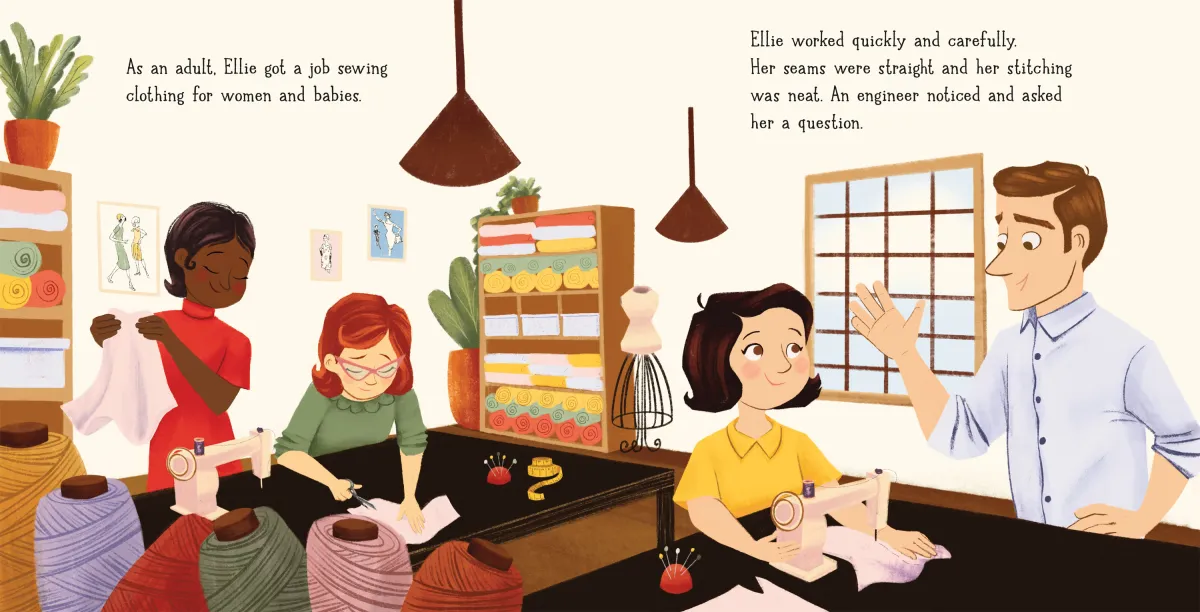 Photo: Eleanor Foraker, via www.publisherspotlight.com
The Technical Puzzle Nobody Talks About
The flag itself was made from nylon — a material chosen for its durability, light weight, and ability to hold color under extreme conditions. But nylon alone wasn't the hard part.
The hard part was the horizontal rod.
Because the Moon has no wind, a flag planted in the lunar soil would simply hang limp — a drooping rectangle that would read as flat and lifeless on camera. NASA engineers devised a solution: a telescoping horizontal rod sewn into the top hem of the flag, which would hold it extended outward, giving the appearance of a flag caught mid-wave. The rod had to be sewn into the hem with enough precision that it could telescope out cleanly after being folded for transit, without bunching or snagging the fabric.
Foraker and her colleagues sewed that hem by hand and by machine, working to tolerances that left almost no margin for error. The stitching had to be strong enough to hold the rod under tension without tearing the nylon. It had to be even enough that the flag would hang straight. And it had to be light enough not to add unnecessary weight to the payload.
They got it right. But it took time, care, and the kind of quiet professional pride that never shows up in mission reports.
The Flag That Almost Didn't Wave
Here's a detail that doesn't make it into most history books: the famous image of the Apollo 11 flag appearing to wave is actually a result of the installation process, not a breeze.
When Armstrong and Aldrin planted the flagpole in the lunar soil, they had trouble driving it deep enough — the surface was harder than expected just a few inches down. The flag wobbled and rotated as they worked with it, and because there was no air resistance to dampen the motion, it kept moving for several seconds after they let go. The cameras caught that motion, and the image became iconic.
The flag was also, by some accounts, nearly bleached white by the rocket exhaust from the lunar module's ascent engine when Armstrong and Aldrin departed. Later Apollo missions planted their flags at greater distances from the landing site to avoid the same problem.
But the flag survived the journey. The stitching held.
Six Flags, Six Missions, One Small Team
Apollo 11 wasn't the only mission that needed flags. NASA ultimately planted flags on the lunar surface during six successful Apollo landings, from 1969 through 1972. Annin's team produced flags for all of them, each one built to the same demanding specifications, each one hand-finished with the same care.
The flags were not expensive by NASA standards. The agency reportedly paid around $5.50 per flag — a number that feels almost absurdly small against the backdrop of a program that cost tens of billions of dollars. But price was never the point. The point was precision. The point was that someone had to do this work, and it had to be done exactly right.
Eleanor Foraker and her colleagues did it right. They showed up, read the specs, threaded the machines, and stitched America's most famous symbol into something that could survive the harshest environment human beings had ever attempted to reach.
The Names That Didn't Make the History Books
When the Apollo 11 crew returned to Earth, they were celebrated with ticker-tape parades, presidential dinners, and world tours. Their names are permanently etched into the American story.
The seamstresses went back to work.
This is not unusual. The history of great American achievements is full of quiet contributors whose labor made the celebrated moments possible. The women who computed orbital trajectories at NASA before computers could. The factory workers who built the Saturn V components. The technicians who hand-soldered the circuit boards that guided the lunar module to the surface.
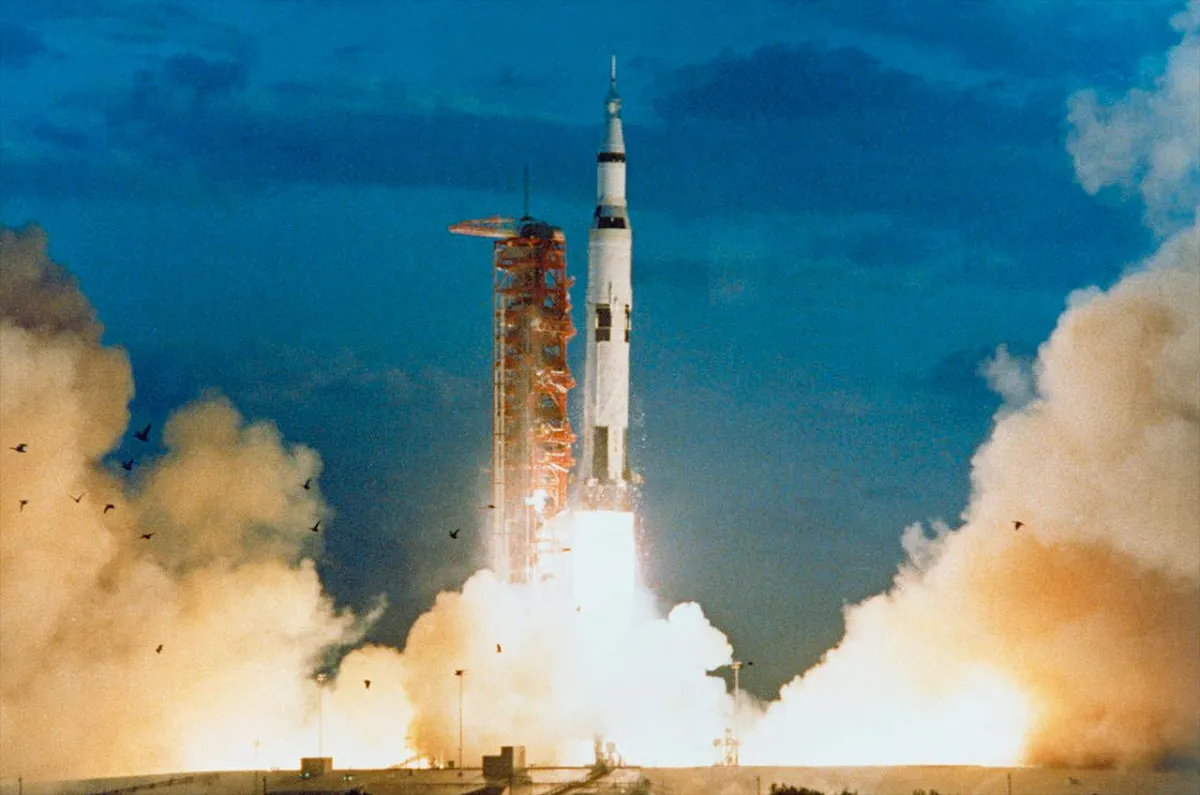 Photo: Saturn V, via cdn.mos.cms.futurecdn.net
But there's something particularly striking about the flag story, because the flag was the image. It was the symbol. It was the thing that billions of people saw and remembered. And it was made by human hands, in a Pennsylvania factory, by workers who were given an impossible set of requirements and told to figure it out.
They did. That's the whole story, really. They were handed something hard, something that had never been done before, and they brought to it the same steady, professional competence they brought to every other job. No fanfare. No press conferences. Just good work, done carefully, in service of something larger than themselves.
The Quiet Ones Who Hold It All Together
There's a version of the American achievement story that focuses entirely on the visionaries — the engineers, the commanders, the men in the control room with the headsets and the clipboards. That version isn't wrong. Those people were extraordinary.
But every great achievement is also held together by people who never make the poster. The ones who show up, do the work, and trust that the work matters even when nobody's watching.
Eleanor Foraker stitched a flag that went to the Moon. She did it with her hands, with industrial thread, and with the kind of careful attention that separates good work from great work.
The Moon is still up there. The flags are still on it — or what's left of them, after decades of radiation and temperature extremes. The stitching did its job.
That's grit. That's glory. And it happened in a factory in Pennsylvania, at a sewing machine, by someone whose name you've probably never heard until now.